


LAET Students Soar to Third Place at Hack Club Haven London

Last week, a team of students from LAET alongside a teammate from Broxbourne School secured third place at Hack Club Haven London with an inventive, camera-controlled take on a mobile gaming classic.
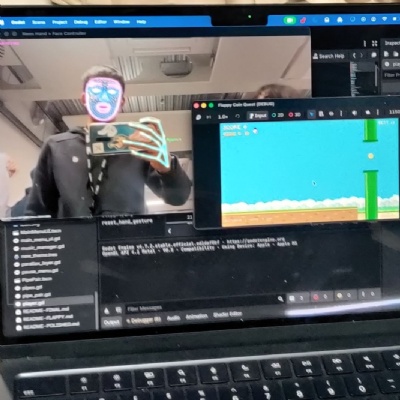
Working to the event's "Bounce Back" theme, the group had just over seven hours, from 10am until the 5.30pm deadline, to design and build a playable game from scratch. Their creation, Happy Bird, puts a new spin on the familiar mechanics of Flappy Bird, replacing traditional buttons and touchscreens with hand movements and facial gestures.
"Moving your hand upwards made the bird flap, nodding took you back to the main menu, and holding up a certain number of fingers let you select menu options," explained LAET student Daksh, who led the programming using Python (MediaPipe and OpenCV) alongside the Godot game engine. "The finger counting idea sounded a little crazy at first, but we managed to make it work!"
Creating the game's futuristic, neon-inspired look and sound was a team effort. While Daksh developed the computer vision controls and code, fellow LAET student Sarah designed the artwork, and LAET's Joanne worked with Aedan from Broxbourne School to compose the soundtrack.


The team faced a few technical challenges along the way. Getting the camera to recognise gestures reliably under the venue's lighting proved particularly tricky. "Nod detection was especially unpredictable," Daksh recalled. "Sometimes it was too sensitive, and other times someone practically had to bow to get it working! We kept testing the game with different people and adjusting the sensitivity until it felt right."
There was also a last-minute scare during the voting stage, when attendees couldn't find Happy Bird on the platform. After a teammate alerted the organisers, the portal was reopened to make sure the game was correctly listed.
After all this, the team weren't expecting to finish among the top entries. "Honestly, I wasn't expecting us to place at all," Daksh admitted. "After the submission issue, I thought we might not even make the top ten. When Happy Bird appeared on the projector in third place, we were sitting towards the back and practically shouted, 'YES, THAT'S US!' It was particularly rewarding seeing how much people enjoyed the game. One person even said they weren't leaving until they'd beaten the previous high score!"


The team hopes to continue developing Happy Bird, with plans to improve the gesture detection and make the controls even smoother. Daksh is also keen to explore how similar computer vision techniques could be used beyond gaming.
For students thinking about entering a hackathon themselves, Daksh's advice is to focus on fresh ideas and make the most of everyone's different strengths. "I'd say originality doesn't always mean inventing something completely new," he shared. "We took a game almost everyone already knows and gave it an unusual twist. People immediately understood the gameplay, and the unconventional controls naturally drew their attention."
He added: "There's room for programmers, artists, musicians and people who enjoy coming up with ideas. Having a team with different strengths can make all the difference. Above all, the experience of building something together under time pressure, experimenting with ambitious ideas and seeing everyone else's creativity is worth far more than any award."